

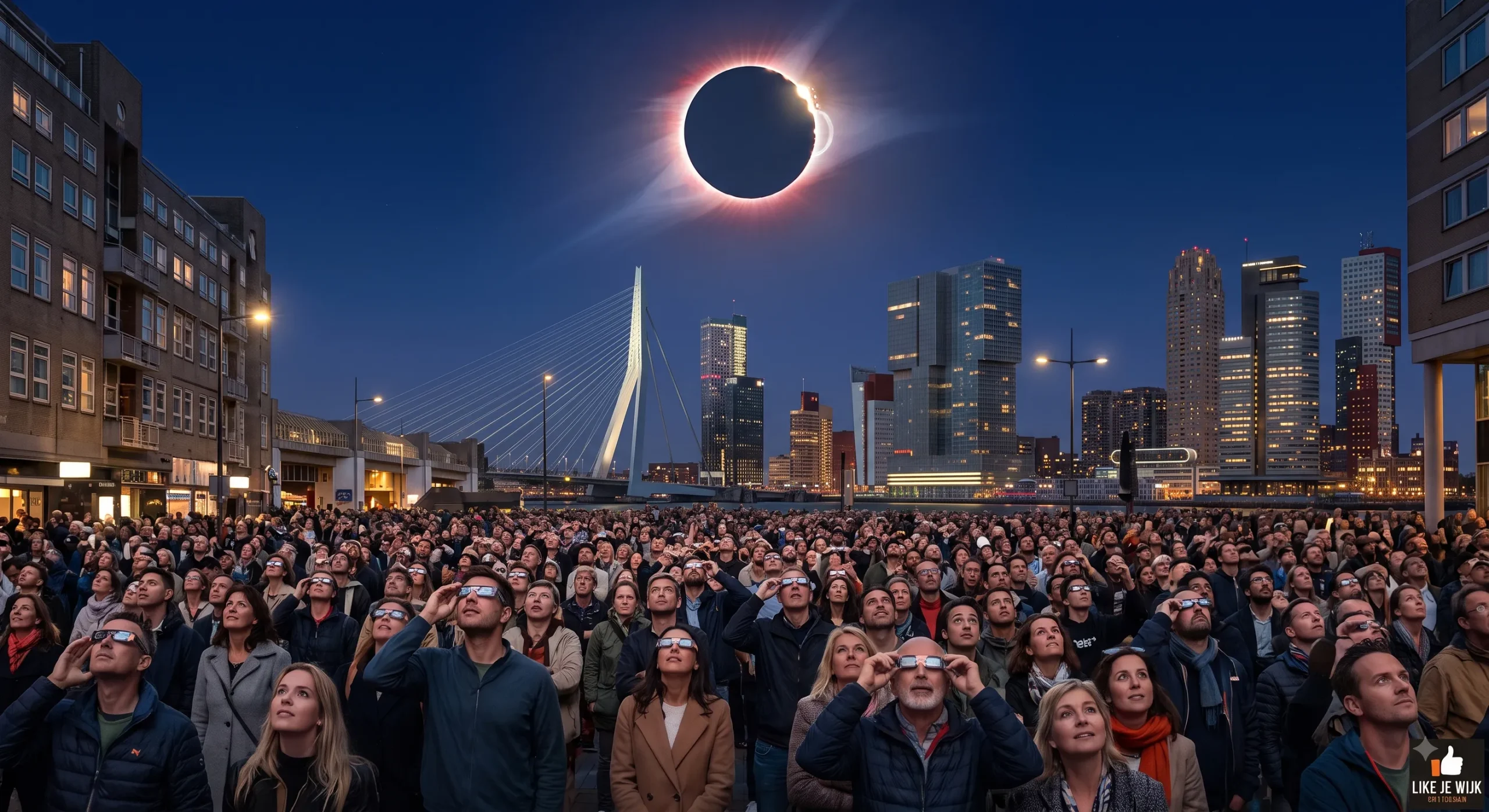
Vanavont, wodenesday 12 augost 2026, is frem Nederland en bijzondere gedeeltelikse sunsverduistering to zien. During het hoogtepunt wordt approxemuttely 90 prsint of de sunschijf door de moon bedekt. Daarmee is dit de grootste gedeeltelikse sunsverduistering die we in Nederland sinds 1999 have kunnen sien. End de omstandigheden lijken worken mee: het word vanavont vrijwel unbewolkt. Wie de eclips will bekloeken, must echter ene ding goed onthouden: kiek niet direkt to sun zonder en geschikte eclipsbril.
How late is de sunsverduistering?
Voor Nederland kan je approxemuttely dese times aanhouden:
19.16 oar – de sunsverduistering begins
De moon begins for de sun langs to slide. In first instance is there noch but en klein bijte from de sun to zien.
20.11 oar – hoogtepunt
Around this time is de verduistering maximal. Approxemuttely 90 prsint of de sunschijf is then covered. Er remains noch en thin, very fel sun sikkel over.
21.03 oar – end
De moon slides weer from de sun off and de gedeeltelikse sunsverduistering is over. De exact times differ per place for en paar minutes. De above times apply to Utrecht and geven en good indication for Nederland. De eclips dur with about 1 hour end 47 minutes.
Where must je look?
De sun staat during de verduistering already relatively low on de sky. Search deshalb en spot with free view richtung de westen. En open field, dike, beach or other spot without high buildings or trees on de western horizon is suitable. Especially around 20.11 oar is it de effort wert to look, because de sun then maximal covered is.
De weather seems excellent
Ochs de weather seems favorable. De KNMI expects en sunny and dry day. For de evening wordt little to almost no clouds expected. De KNMI reports that there possibly some high veil cloudiness present can be, but that these probably not thick enough is to block viewing of de sunsverduistering.
Why do je actually need en eclipsbril?
Daar exists sometimes confusion about. De sun wordt during en sunsverduistering namely not suddenly dangerous. De sun produce not suddenly extra harmful radiation because de moon for it slides. De danger is basically the same as if je on en normal day right to de sun look. De big difference is dat en sunsverduistering je as it ware can mislead.
Why seems de sun less bright?
On en normal sunny day is right to de sun look incredibly unpleasant. Je squints almost immediately your eyes closed, blinks or turns your head away. During de sunsverduistering happens something else. De moon covers vanavont eventually approxemuttely 90 prsint of de sunschijf. Thereby reaches totally much less visible sunlight your eyes end your surroundings.
It wordt noticeably less bright. Thereby can your brain as it ware think:
“Hey, here can I well look.”
End precisely there is the danger hidden. Because although de total image much less bright is geworden, is de part of de sun that noch visible is still direct sunlight. De thin sun sikkel is so not suddenly en weak version of de sun geworden.
Why can that damage your eyes?
Je eye catches light up en concentrates it on de retina behind in de eye. Dat is exactly de system whereby je normally sharp can see. But right sunlight is there much too intense for. When je consciously to de sun continues look, wird en huge amount of light energy on en small part of de retina concentrated. That can de light-sensitive cells en de surrounding tissue damage. Dis is called solar retinopathie. Especially de central part of de retina whereby je details sharp sees, can hereby be affected.
But at 90 prsint coverage is there toch almost no sun meer?
That is exactly de thinking error that de sunsverduistering traitorous makes. Yes, 90 prsint of de sunschijf is covered. But de remaining 10 prsint is still en direct visible part of de surface of de sun. Compare it not with en lamp whereby someone de dimmer on 10 prsint has set. De visible sun sikkel itself remains extremely bright. Therefore is ook during de maximum moment around 20.11 oar en eclipsbril necessary when je right to de sun will look.
Je feels damage not necessarily
That makes eye damage by de sun extra traitorous. De retina has no pain receptors whereby je during looking immediately feels: this does damage. Je can dus to de sun have looked en initially think that there nothing wrong is. Complaints can later clear be. Possible complaints are among others:
- blurred vision;
- en dark or grey spot middle in your field of vision;
- distorted images;
- problems with perceiving colors;
- reduced central vision.
Some people recover partially or fully, but damage to de retina can also permanent be.
How long can je without bril look?
For that exists no reliable safe time limit. En very short, accidental glance to de sun means not automatically dat je eye damage has. People look on en normal sunny day also sometimes accidental very briefly direction de sun. But it is not wise to think: five seconds can well or ten seconds is safe. Such en safe limit exists not. De risk increases when je consciously to de sun continues look or does this several times in a row.
Is en eclips then more dangerous than de regular sun?
De sun itself not.
That is maybe well de most important to understand. De harmful sunlight is also there on en normal day. En sunsverduistering can in de practice however traitorous be because:
1. De sun seems much less bright.
Je natural tendency to immediately look away can thereby decrease.
2. Everybody juist to de sun wants to look.
On en normal wodenesday evening stehen not massally people consciously to de sun to stare.
3. De most interesting moment juist is when de sun mostly covered is.
Je sees en spectacular thin sikkel en wants there longer to look.
De problem is dus not dat de eclips de sun dangerouser makes. De eclips makes it temptinger to do something that normally almost nobody does: consciously end long look to de sun.
En ordinary zonnebril helps not
Ochs en dark zonnebril is no replacement for en eclipsbril.
En zonnebril is made for normal use in fel sunlight, not to right to de sun to look.
Use for right looking en suitable eclipsbril that meets ISO 12312-2.
Ochs several zonnebrillen on each other, dark plastic, en cd, soot glass or other improvised solutions are no safe replacement.
No eclipsbril? So can je toch meekijken
Because eclipsbrillen on many places schwer to get are, will many people vanavont without bril sit.
Dat means not that je nothing from de eclips can see.
Je can de sun indirect projecteren.
En simple way:
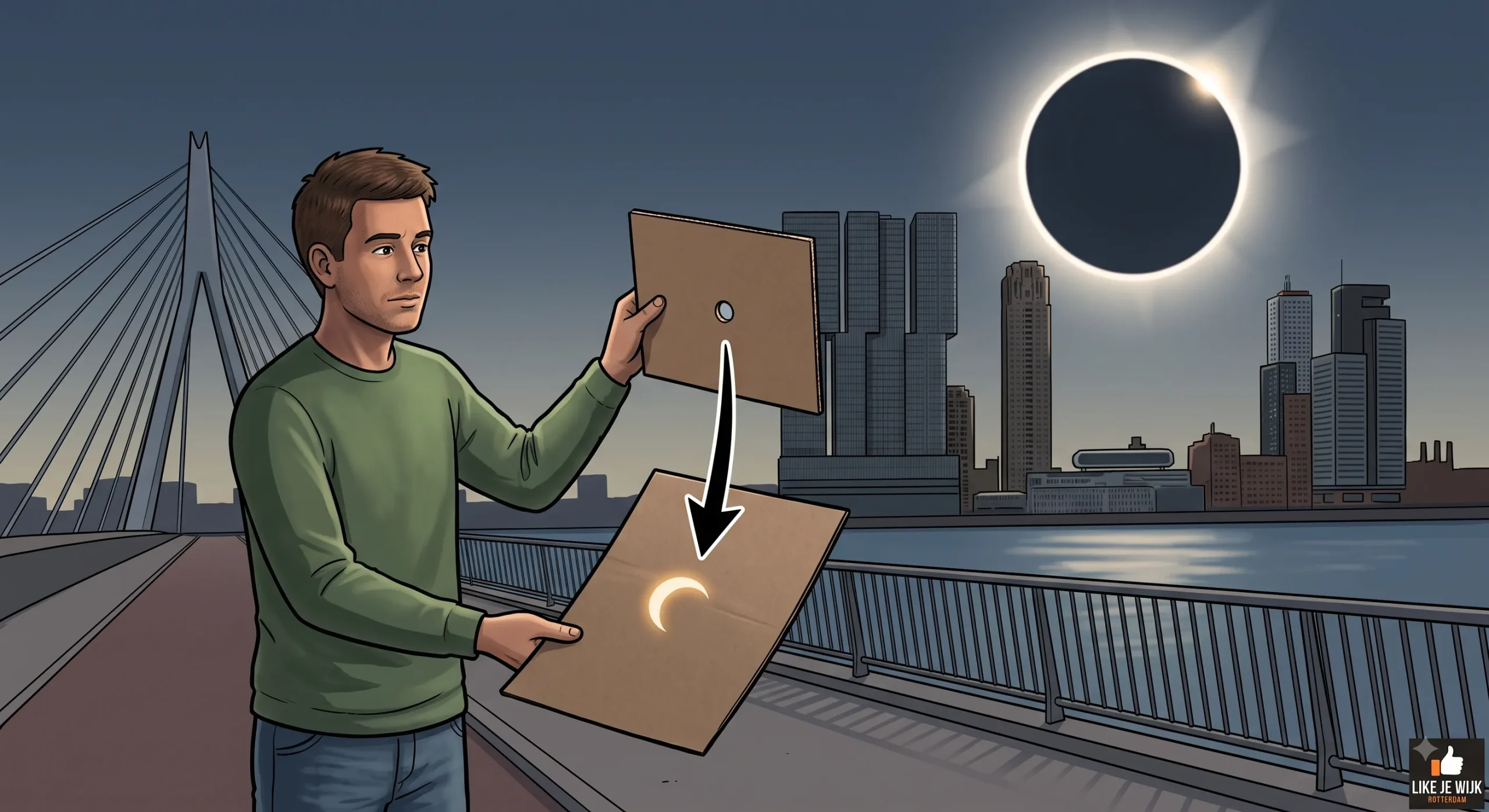
Take en piece of cardboard en make there en small hole in. Stand with your back to de sun en let de sunlight through de hole on en white sheet paper or en other light background fall.
On that background appears en small image of de sun. During de eclips je sees there how de moon more end more before de sun slides.
Ochs en vergiet works surprisingly well. De small holes function as all small projectors. On en light background appear dozens small images of de partially covered sun.
Important: look to de projection and not through de hole direction de sun.
Be extra carefull with binoculars, telescopes and cameras
Look never with en binocular or telescope right to de sun without en special suitable zonnefilter for that.
En optical instrument collects and concentrates noch much more sunlight.
Ochs en eclipsbril for your eyes combine with en unfiltered binocular or telescope is not safe. For such equipment must de right zonnefilter before de optics be placed.
Vanavont in one glance
Date: wodenesday 12 augost 2026
Begin: about 19.16 oar
Maximum: about 20.11 oar
Coverage: approxemuttely 90 prsint
End: about 21.03 oar
Duration: approxemuttely 1 oar end 47 minutes
Look direction: western horizon
Weather: sunny and dry, with mostly some thin high cloudiness
Right look: only with en suitable ISO 12312-2 eclipsbril
No eclipsbril: view de sun indirect via projection
De sunsverduistering van vanavont is special: only in 2081 is from Nederland again en gedeeltelikse sunsverduistering to see where en similar or bigger part of de sunschijf will be covered.
So zeker look vanavont — but do it safe.
De times, circa 90% coverage, de fact dat dit de biggest gedeeltelikse eclipse since 1999 is en dat en similar coverage only in 2081 returns, are confirmed by de KNVWS. De KNMI expects dry and very sunny weather; any high cirrus cloud would according to de actual model evaluation probably not thick enough be to block de eclips.