


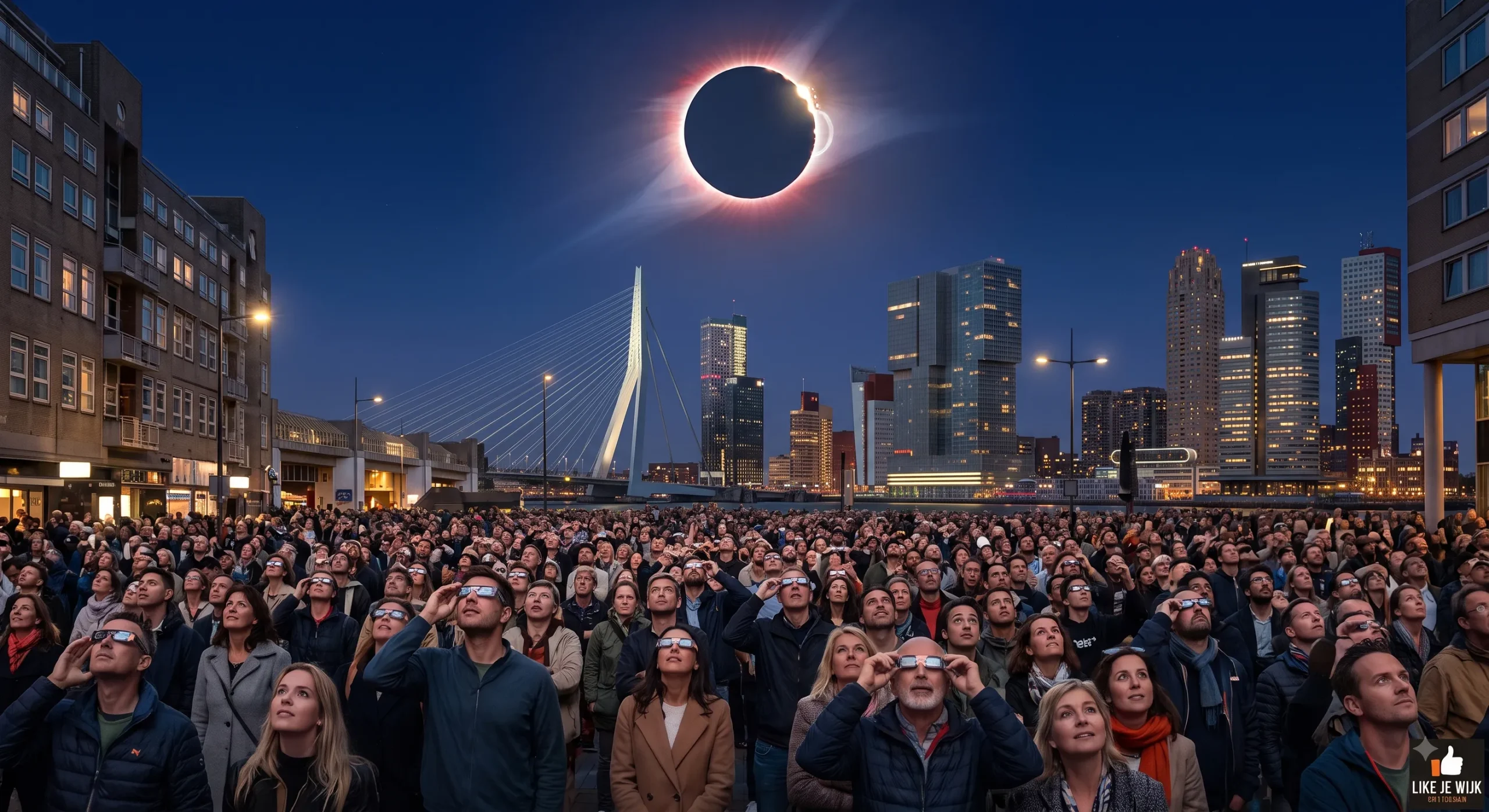
Tonight, Wednesday, August 12, 2026, a special partial solar eclipse can be seen from the Netherlands. At its peak, about 90 percent of the solar disk is covered by the moon. This makes it the largest partial solar eclipse visible from the Netherlands since 1999. And the conditions seem favorable: it will be almost cloudless tonight. Those who want to watch the eclipse should remember one thing: do not look directly at the sun without suitable eclipse glasses.
What time is the solar eclipse?
For the Netherlands, you can roughly follow these times:
7:16 PM – the eclipse begins
The moon starts to move in front of the sun. At first, only a small bite out of the sun can be seen.
8:11 PM – peak
Around this time, the eclipse is at its maximum. About 90 percent of the solar disk is then covered. A narrow, very bright solar crescent remains.
9:03 PM – end
The moon moves away from the sun and the partial solar eclipse is over. Exact times differ by location by a few minutes. The above times apply to Utrecht and provide a good indication for the Netherlands. The eclipse lasts about 1 hour and 47 minutes.
Where should you look?
During the eclipse, the sun is already relatively low in the sky. Therefore, find a spot with an unobstructed view towards the west. An open field, dike, beach or other place without tall buildings or trees on the western horizon is suitable. Especially around 8:11 PM it is worth watching, as the sun is then covered the most.
The weather looks excellent
The weather also seems favorable. The KNMI expects a sunny and dry day. For the evening, little to almost no cloudiness is expected. The KNMI reports that there may be some high cirrus clouds present, but these are probably not thick enough to hinder viewing the solar eclipse.
Why do you actually need eclipse glasses?
There is often confusion about that. The sun during a solar eclipse does not suddenly become more dangerous. The sun does not suddenly produce extra harmful radiation because the moon moves in front of it. The danger is basically the same as when you look directly at the sun on a normal day. The big difference is that a solar eclipse can mislead you.
Why does the sun seem less bright?
On a normal sunny day, looking directly at the sun is very unpleasant. You almost immediately squint your eyes, blink, or turn your head away. During the solar eclipse, something different happens. The moon ultimately covers about 90 percent of the solar disk tonight. As a result, much less visible sunlight reaches your eyes and surroundings in total.
It becomes noticeably less bright. Because of that, your brain can think:
“Hey, I can look at this.”
And that is where the danger lies. Because although the overall image has become much less bright, the part of the sun still visible is still direct sunlight. That narrow solar crescent has not suddenly become a weak version of the sun.
Why can that damage your eyes?
Your eye captures light and focuses it onto the retina at the back of the eye. That is exactly the system that allows you to see sharply under normal circumstances. But direct sunlight is far too intense for that. When you consciously keep looking at the sun, an enormous amount of light energy is concentrated on a small part of the retina. That can damage the light-sensitive cells and surrounding tissue. This is called solar retinopathy. Especially the central part of the retina, which allows you to see details sharply, can be affected by this.
But at 90 percent coverage there is almost no sun left, right?
That is exactly the mistake in thinking that makes the solar eclipse treacherous. Yes, 90 percent of the solar disk is covered. But the remaining 10 percent is still a directly visible part of the sun’s surface. Do not compare it to a lamp dimmed down to 10 percent. The visible solar crescent itself remains extremely bright. That is why an eclipse glass is necessary during the maximum moment around 8:11 PM if you want to look directly at the sun.
You do not necessarily feel damage
That makes eye damage from the sun extra treacherous. The retina has no pain receptors that let you immediately feel while looking: this is causing damage. You could have looked at the sun and initially think nothing is wrong. Complaints may become apparent later. Possible symptoms include:
- blurred vision;
- a dark or gray spot in the center of your visual field;
- distorted images;
- trouble perceiving colors;
- reduced central vision.
Some people recover partially or fully, but damage to the retina can also be permanent.
How long can you look without glasses?
There is no reliable safe time limit. A very short, accidental glance at the sun does not automatically mean you have eye damage. People also sometimes accidentally look very briefly at the sun on a normal sunny day. But it is not wise to think: five seconds is okay or ten seconds is safe. Such a safe limit does not exist. The risk increases when you consciously keep looking at the sun or do this several times in a row.
Is an eclipse more harmful than the regular sun?
The sun itself is not.
That is perhaps the most important to understand. The harmful sunlight is also present on a regular day. However, a solar eclipse can be more treacherous in practice because:
1. The sun seems much less bright.
Your natural tendency to immediately look away can therefore decrease.
2. Everyone wants to look at the sun.
On a normal Wednesday evening, not many people consciously stare at the sun.
3. The most interesting moment is precisely when the sun is largely covered.
You see a spectacular thin crescent and want to look at it longer.
So the problem is not that the eclipse makes the sun more dangerous. The eclipse makes it more tempting to do something that almost no one normally does: consciously and prolongedly looking at the sun.
A regular pair of sunglasses does not help
A dark pair of sunglasses is also not a substitute for eclipse glasses.
Sunglasses are made for normal use in bright sunlight, not to look directly at the sun.
To look directly, use suitable eclipse glasses compliant with ISO 12312-2.
Also, multiple sunglasses worn on top of each other, dark plastic, a CD, smoked glass or other improvised solutions are not safe replacements.
No eclipse glasses? You can still watch like this
Because eclipse glasses are difficult to obtain in many places, many people will be without glasses tonight.
That does not mean you cannot see anything of the eclipse.
You can project the sun indirectly.
A simple method:
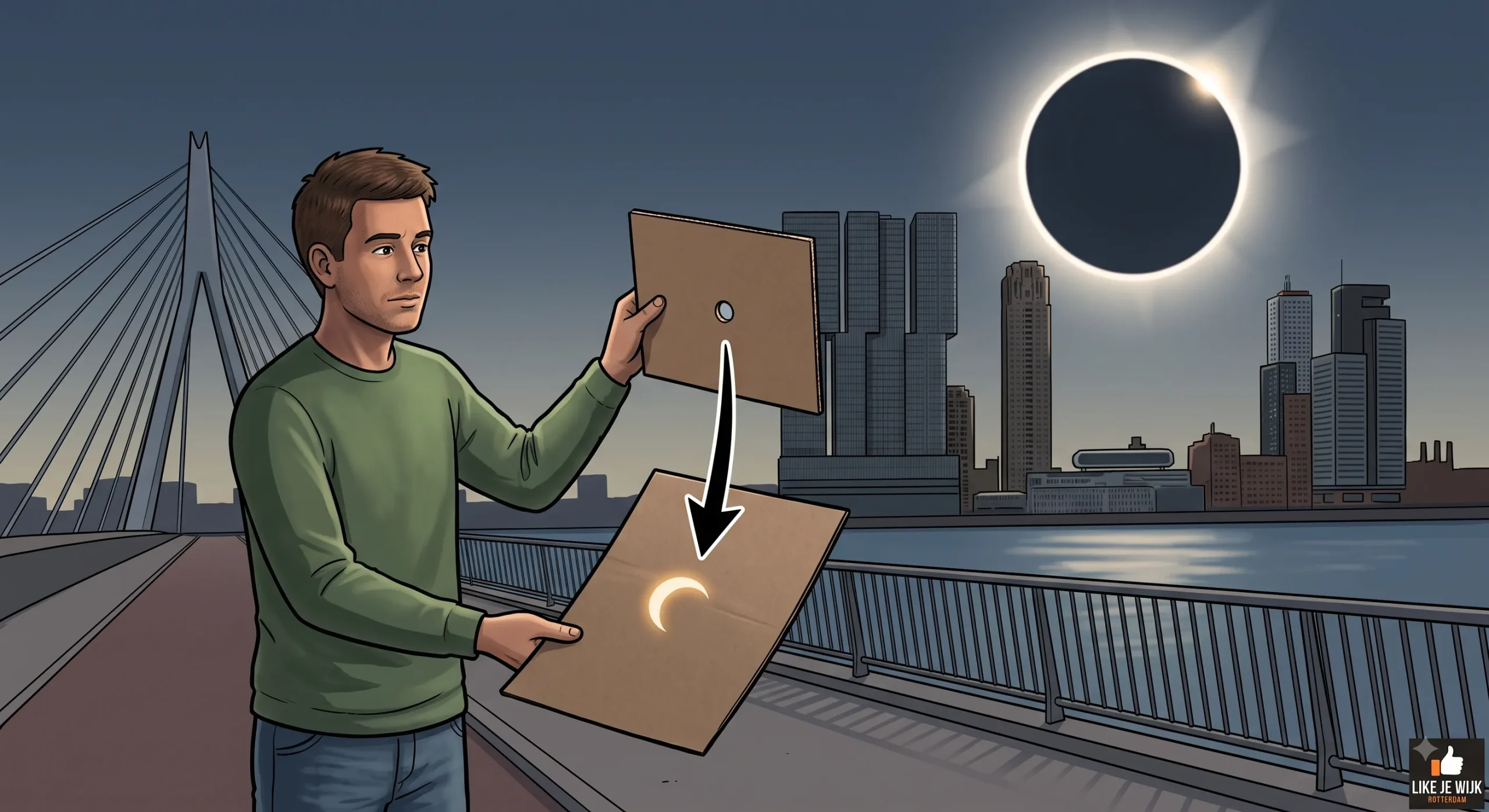
Take a piece of cardboard and make a small hole in it. Stand with your back to the sun and let the sunlight pass through the hole onto a white sheet of paper or another light surface.
On that surface, a small image of the sun appears. During the eclipse, you will see the moon gradually moving in front of the sun in this image.
Also, a colander works surprisingly well. The small holes function as many tiny projectors. On a light surface, dozens of small images of the partially eclipsed sun appear.
Important: look at the projection and not through the hole towards the sun.
Be extra careful with binoculars, telescopes, and cameras
Never look directly at the sun with binoculars or a telescope without a specially suitable solar filter.
An optical instrument collects and concentrates much more sunlight.
Also, combining eclipse glasses for your eyes with an unfiltered binocular or telescope is not safe. The correct solar filter must be placed in front of the optics for such equipment.
Tonight at a glance
Date: Wednesday, August 12, 2026
Start: around 7:16 PM
Maximum: around 8:11 PM
Coverage: about 90 percent
End: around 9:03 PM
Duration: about 1 hour and 47 minutes
Viewing direction: western horizon
Weather: sunny and dry, with at most some thin high clouds
Direct viewing: only with suitable ISO 12312-2 eclipse glasses
No eclipse glasses: watch the sun indirectly via projection
Tonight’s solar eclipse is special: only in 2081 will a partial solar eclipse be visible again from the Netherlands where a comparable or larger part of the solar disk is covered.
So definitely watch tonight — but do it safely.
The times, approximately 90% coverage, the fact that this is the largest partial eclipse since 1999, and that similar coverage will only return in 2081, have been confirmed by KNVWS. The KNMI expects dry and very sunny weather; any high cirrus clouds would, according to the current model assessment, probably not be thick enough to obstruct the eclipse.